BMI Couldn't See My Lipedema
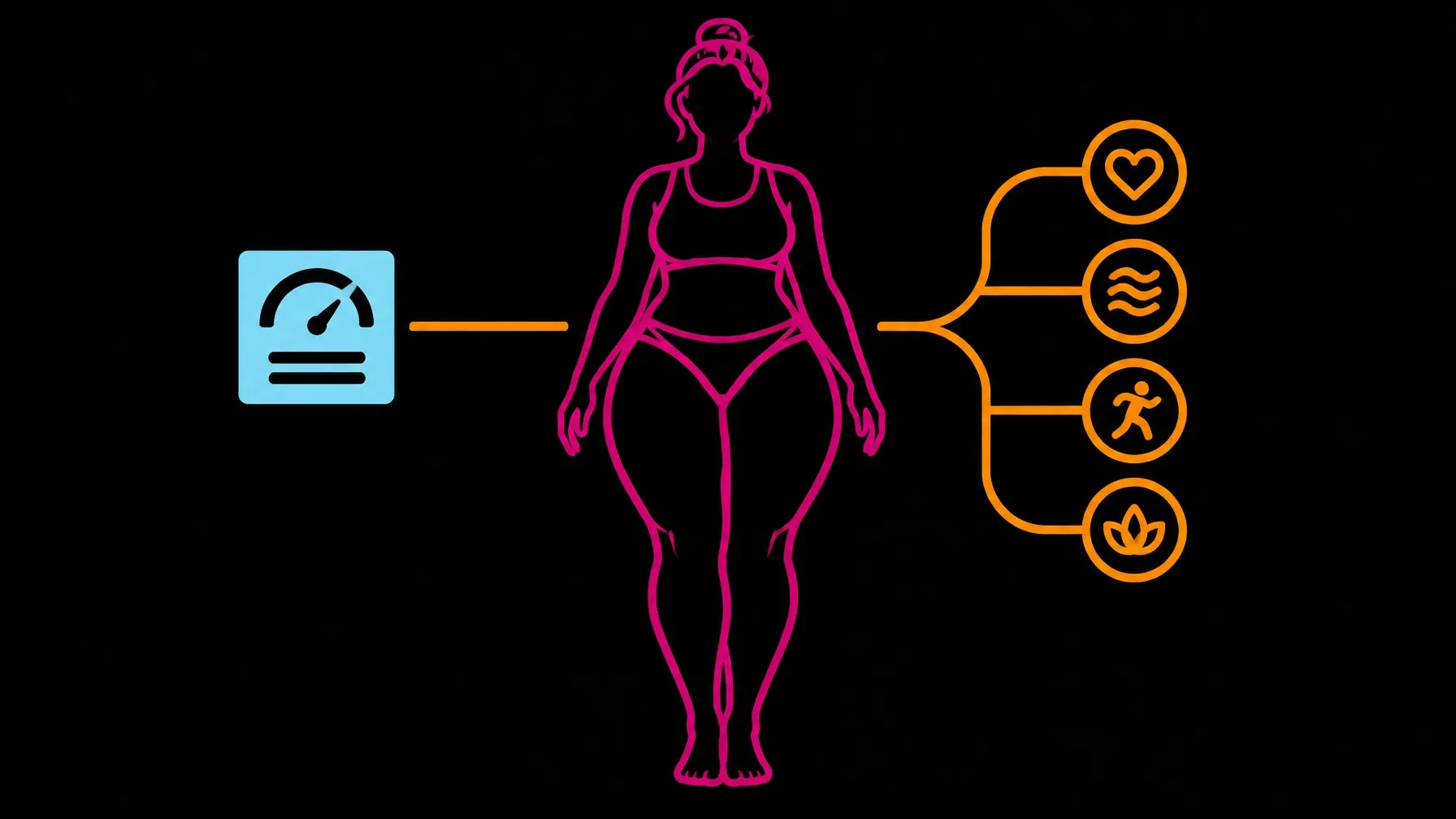
For more than half my life, I've had a number attached to my body. Morbidly obese. And along with that number often came an assumption: I must eat too much. There's one enormous problem with that story. I frequently struggle to eat enough. I'm a chronic under-eater. My BMI never knew that. Because BMI has never measured what I eat.
Personal experience shared by Gigi, founder of Core and Curve Lab, who lives with Stage 4 Lipedema. This experience is not clinical evidence, a diagnosis, or medical advice.
Coaching for fluctuating-capacity bodies starts with better questions, not a harsher label.
Built for bodies that don't have the same capacity every day.
On this page
What BMI actually measures
BMI is a calculation:
Weight ÷ height²
That is all it measures.
It does not directly measure:
- Body-fat percentage
- Fat distribution
- Muscle mass
- Lipedema tissue
- Nutrition
- Food intake
- Fitness
- Metabolic health
- Physical function
BMI can be useful for screening and population research. It can help researchers compare large groups of people. It can also be one piece of information in a clinical assessment.
The problem begins when one screening number is treated as a complete explanation of an individual body.
BMI cannot tell whether weight comes mostly from muscle, fat, bone, fluid, or a particular pattern of adipose tissue. It also cannot tell whether someone is eating enough, restricting food, experiencing food insecurity, living with an eating disorder, or taking a medication that affects appetite or weight.
Body size does not diagnose overeating.
Then add Lipedema
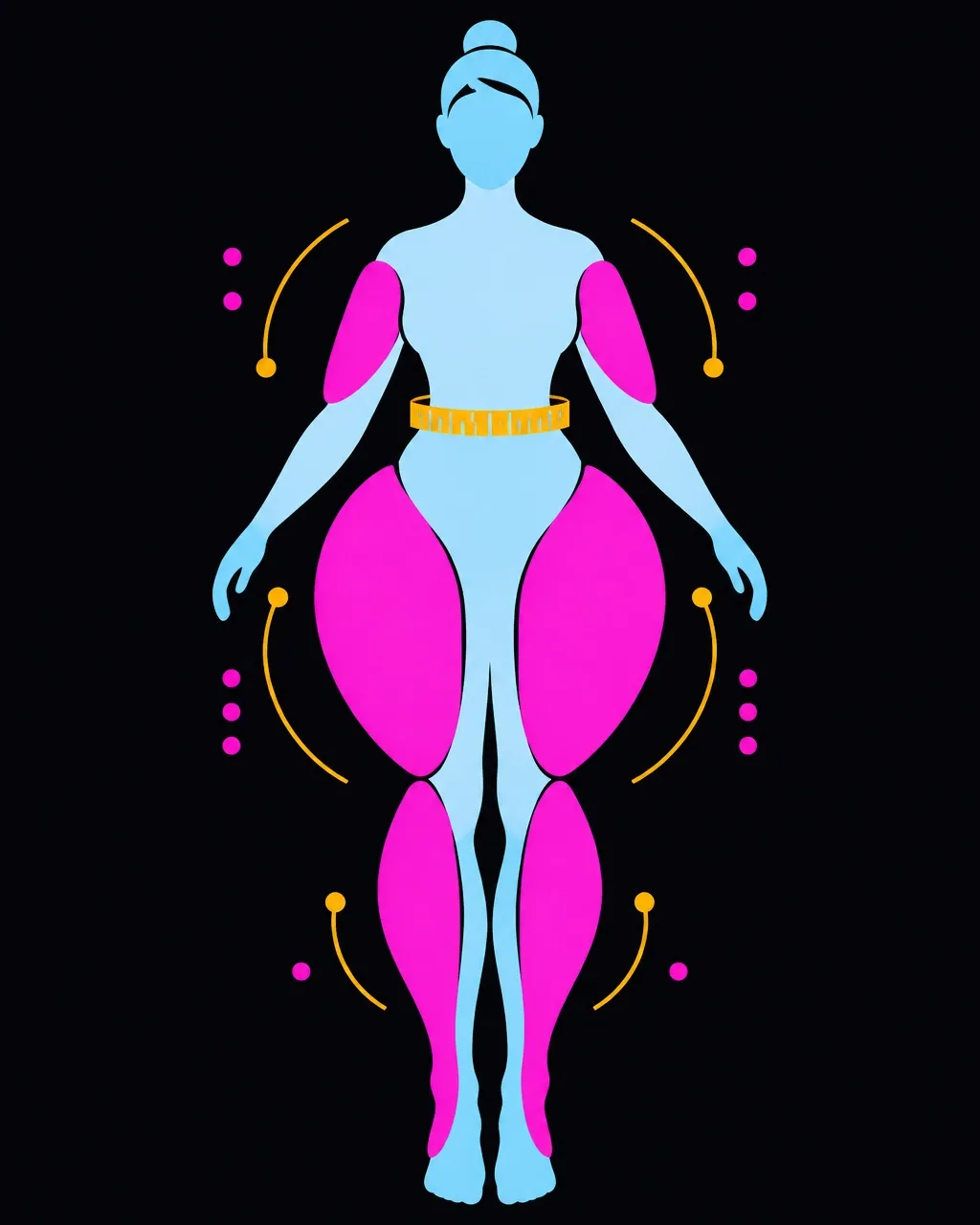
Lipedema commonly involves disproportionate adipose accumulation in the extremities, including the hips, buttocks, thighs, legs, and sometimes the arms.
That creates a specific mathematical problem.
The formula counts all of that tissue as body weight. But it cannot identify which tissue is Lipedema tissue. It cannot recognize the pattern of distribution. It cannot assess tenderness, bruising, heaviness, mobility limitations, or the way symptoms change across the day.
For someone with late-stage lipedema, including lipedema stage 4, the number may reflect a complicated combination of tissue, muscle, bone, and sometimes rapidly variable fluid-associated weight. BMI compresses all of that into one ratio.
The number may be accurate as a calculation. The interpretation can still be incomplete.
Lipedema experts recognize BMI's limits
This is not only a personal frustration. Current guidance and expert consensus recognize the problem.
The Lipedema World Alliance Delphi consensus, published in Nature Communications in 2026 (volume 17, article 427), states that BMI has limited value in distinguishing Lipedema from obesity. It notes that increased extremity adipose tissue can produce falsely high BMI classifications and recommends considering waist-to-height ratio, or WHtR, among additional measurements.
The 2024 German S2k Guideline on Lipedema reaches a similar conclusion. It says BMI is not conclusive for classifying overweight in people with Lipedema because disproportionate adipose tissue in the extremities can produce falsely high values. The guideline recommends using additional measurements.
These sources do not say BMI has no value. They say BMI should not be asked to answer a question it was not designed to answer.
Built for bodies that don't have the same capacity every day.
That includes bodies whose shape, symptoms, mobility, and fluid status can change over time.
My son's athletic body taught me another lesson
When my son was 15, he was athletic and muscular. BMI classified him as obese.
That result did not automatically tell us what was happening in his body. It told us that his weight was high compared with his height according to the formula.
The American Academy of Pediatrics has acknowledged that BMI can be falsely elevated in muscular teens and athletes. Body composition can provide more useful information about the balance of fat mass and lean mass.
This is our family's experience, shared with permission. I am not sharing his name, photo, sport, or identifying details.
The lesson is not that a clinician should simply diagnose a person by looking at them. Visual judgment is not enough either. The lesson is that when a screening result does not fit the person's body and clinical picture, it needs context and further assessment.
Muscle has mass. BMI cannot distinguish muscle from fat.
The rest of medicine is questioning BMI-only thinking
The 2025 Lancet Diabetes & Endocrinology Commission on clinical obesity also challenged BMI-only thinking.
The Commission found that BMI can both overestimate and underestimate adiposity. It gives inadequate health information at the individual level when used by itself.
This is not an anti-science argument. It is a more careful use of science.
It is also not an anti-obesity-medicine argument. When obesity is present, evidence-based obesity care, including medication when appropriate, deserves respectful discussion. The starting point should be an accurate assessment rather than an assumption based only on height and weight.
The better questions involve body composition, muscle, and function. What is the person's tissue made of? Where is it distributed? How is the body functioning? What support is appropriate?
What should we look at instead?
There is no single replacement number that can explain every body. A better assessment uses context.
Depending on the person and the clinical question, that may include:
- Waist-to-height ratio
- Waist circumference
- Fat distribution
- Body composition
- DXA, where appropriate
- Muscle mass
- Visceral adiposity
- Blood pressure and metabolic markers
- Complications and symptoms
- Physical function and mobility
- Nutrition and eating history
- Appetite, restriction, binge eating, and food access
- Medications and other health conditions
- Lipedema examination and symptom pattern
A clinician may also consider how someone's weight has changed over time, rather than treating one appointment as the whole story.
For women living with Lipedema, a lipedema-focused examination matters. So do questions about pain, tenderness, bruising, heaviness, mobility, daily function, and rapidly variable fluid-associated weight.
This is where personalized lipedema treatment, lipedema nutrition, movement, bodywork, and lymphatic care can fit into a broader plan. The goal is not to force the body into a number. The goal is to understand what support the person needs.
Lipedema and obesity can coexist
There is an important caution here.
Please do not tell women, "You aren't obese, you just have Lipedema."
That makes the same mistake in reverse.
Lipedema and obesity can coexist. When both are present, both deserve real attention. A person may have disproportionate Lipedema tissue and additional adiposity that affects health, function, or treatment decisions.
The answer is not to replace one oversimplification with another. It is to assess the whole person with care.
Body size does not diagnose overeating
A high BMI cannot, by itself, establish overeating as the cause.
BMI contains no measurement of:
- Food intake
- Appetite
- Calories
- Protein
- Nutritional adequacy
- Binge eating
- Restriction
- Food insecurity
- Absorption
- Medications
It cannot know whether someone is a chronic under-eater. It cannot read a food diary. It cannot assess whether a person is meeting their nutritional needs.
That is why "just lose weight" is not a complete health plan. It is a rejected message when it ignores Lipedema, chronic illness, nutrition, pain, mobility, or fluctuating capacity.
Instead of asking your body to keep up with the plan, we help the plan adapt to the body.
That principle shapes holistic Lipedema management at Core and Curve Lab. It also applies to high-capacity women whose capacity changes from day to day. Nutrition counseling, MovementTracks™, bodywork, and lymphatic care should be responsive, practical, and collaborative.
Built for bodies that don't have the same capacity every day.
Evidence at a glance
🟢 BMI measures weight relative to height and is useful for population research and screening
🟢 BMI does not directly measure body composition
🟢 muscular athletes can be misclassified
🟢 consensus/guidelines recognise BMI's limits in Lipedema
🟢 Lipedema and obesity can coexist
🟢 BMI cannot determine dietary intake
🟡 Which combination of measurements best distinguishes Lipedema-associated disproportionate adiposity from coincident obesity
🔴 "Every woman with Lipedema and a high BMI was falsely diagnosed with obesity."
🔴 "BMI has absolutely no clinical value."
Medical and educational disclaimer
MEDICAL AND EDUCATIONAL DISCLAIMER
This article is educational and does not replace medical care. If you have questions about your body composition, Lipedema symptoms, nutrition, medications, or metabolic health, consider discussing the full picture with a qualified healthcare professional.
Research sources
- Kruppa P, Crescenzi R, Faerber G, et al. Lipedema World Alliance Delphi consensus-based position paper on the definition and management of lipedema. Nature Communications. 2026;17:427. DOI: 10.1038/s41467-025-68232-z — https://doi.org/10.1038/s41467-025-68232-z
- Faerber G, et al. S2k Guideline Lipedema. Journal of the German Society of Dermatology. 2024;22:1303–1315. DOI: 10.1111/ddg.15513 — https://doi.org/10.1111/ddg.15513
- Rubino F, et al. Definition and diagnostic criteria of clinical obesity. The Lancet Diabetes & Endocrinology. 2025;13:221–262. DOI: 10.1016/S2213-8587(24)00316-4 — https://doi.org/10.1016/S2213-8587(24)00316-4
- Carl RL, Johnson MD, Martin TJ, Council on Sports Medicine and Fitness. Promotion of Healthy Weight-Control Practices in Young Athletes. Pediatrics. 2017;140(3):e20171871. DOI: 10.1542/peds.2017-1871 — https://doi.org/10.1542/peds.2017-1871
BMI doesn't need to disappear completely. It needs to be put back in its proper place. It's one measurement. Not a diagnosis of character. Not a food diary. Not a body-composition scan. Not a Lipedema test. And definitely not the whole story.