Your Lymphatic System, Made Simple: Where Lymph Goes, Why Nodes Cluster, and How Movement Helps
Lymphatic education and capacity-aware coaching for people living with Lipedema, lymphedema, lipo-lymphedema, or changing mobility needs.
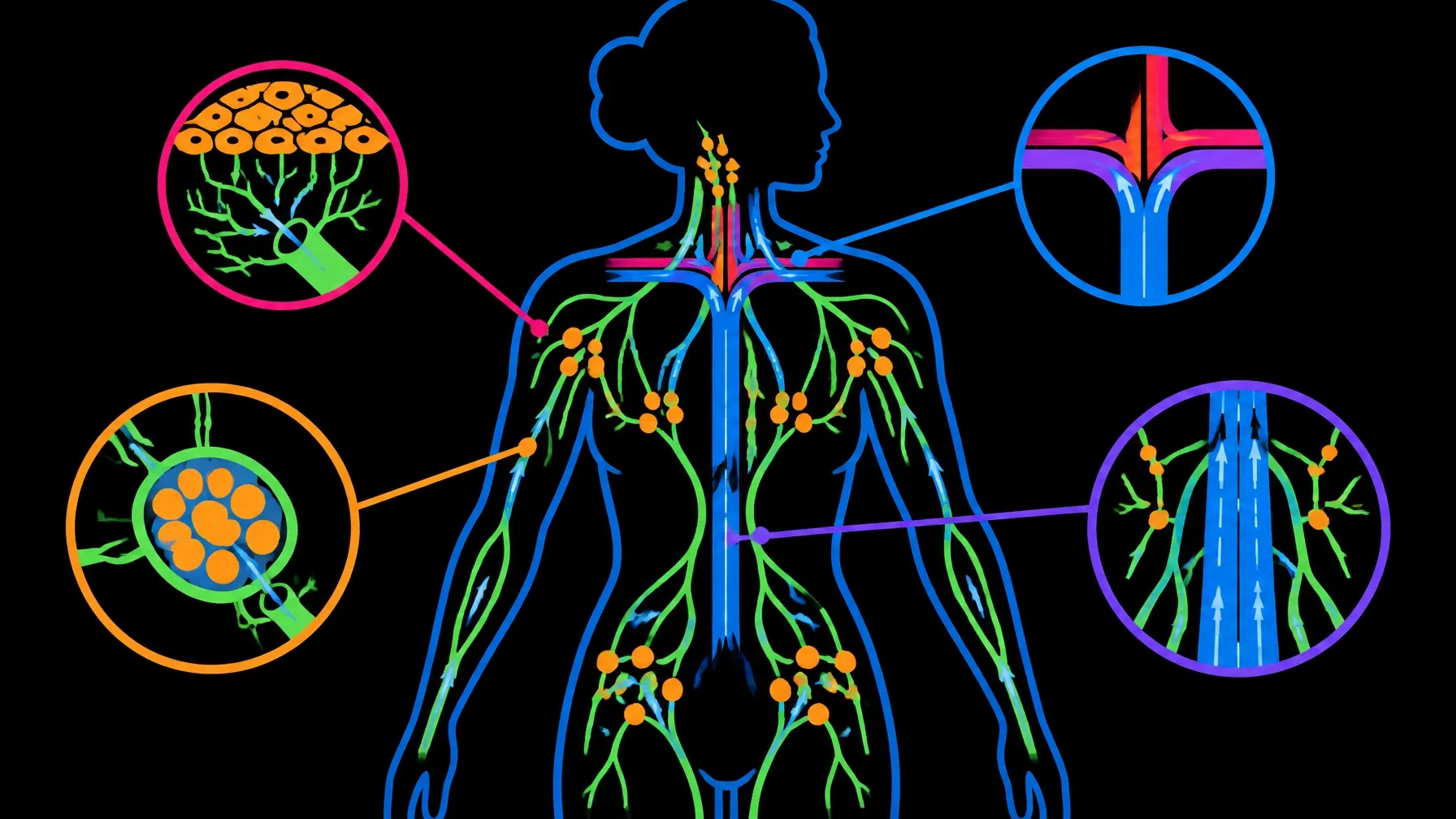
The lymphatic system can sound complicated. A simple map helps.
Think of it as a city:
- Tiny lymph vessels are neighborhood drains.
- Collecting vessels are roads.
- Lymph nodes are security and filter checkpoints.
- Larger trunks and ducts are highways.
- The venous angles near the collarbones are merge points back into the bloodstream.
- Movement and breathing help keep traffic moving.
- The vessels themselves also have small pumps.
On this page
1. What is lymph?
Lymph is fluid collected from the spaces around your cells. It can contain water, proteins, immune cells, cellular debris, and fats absorbed from the digestive system.
Blood vessels deliver fluid and nutrients to tissues. Some fluid leaves the bloodstream and enters the space around cells. The lymphatic system collects part of that fluid and returns it to the blood.
The route is usually:
- Fluid around cells enters tiny lymph vessels.
- It becomes lymph.
- Lymph travels through collecting vessels.
- It passes through regional lymph nodes.
- It moves into larger lymphatic trunks and ducts.
- It returns to the bloodstream near the collarbones.
This system also supports immune surveillance and helps transport dietary fats.
2. What is a lymph node?
A lymph node is a small immune organ positioned along a lymphatic pathway.
In the city analogy, a lymph node is both a checkpoint and a filter station. Lymph enters through vessels on one side, moves through internal spaces containing immune cells, and exits through another vessel.
Nodes help:
- Filter particles and cellular material
- Bring immune cells into contact with foreign material
- Coordinate immune responses
- Process lymph before it continues toward the bloodstream
Nodes are not storage tanks that need to be manually "opened." They are living structures connected to vessels and immune tissue.
3. Where are the major node groups?
Lymph nodes are distributed throughout the body. They are not placed randomly, and they are not all located around joints because those joints move the most.
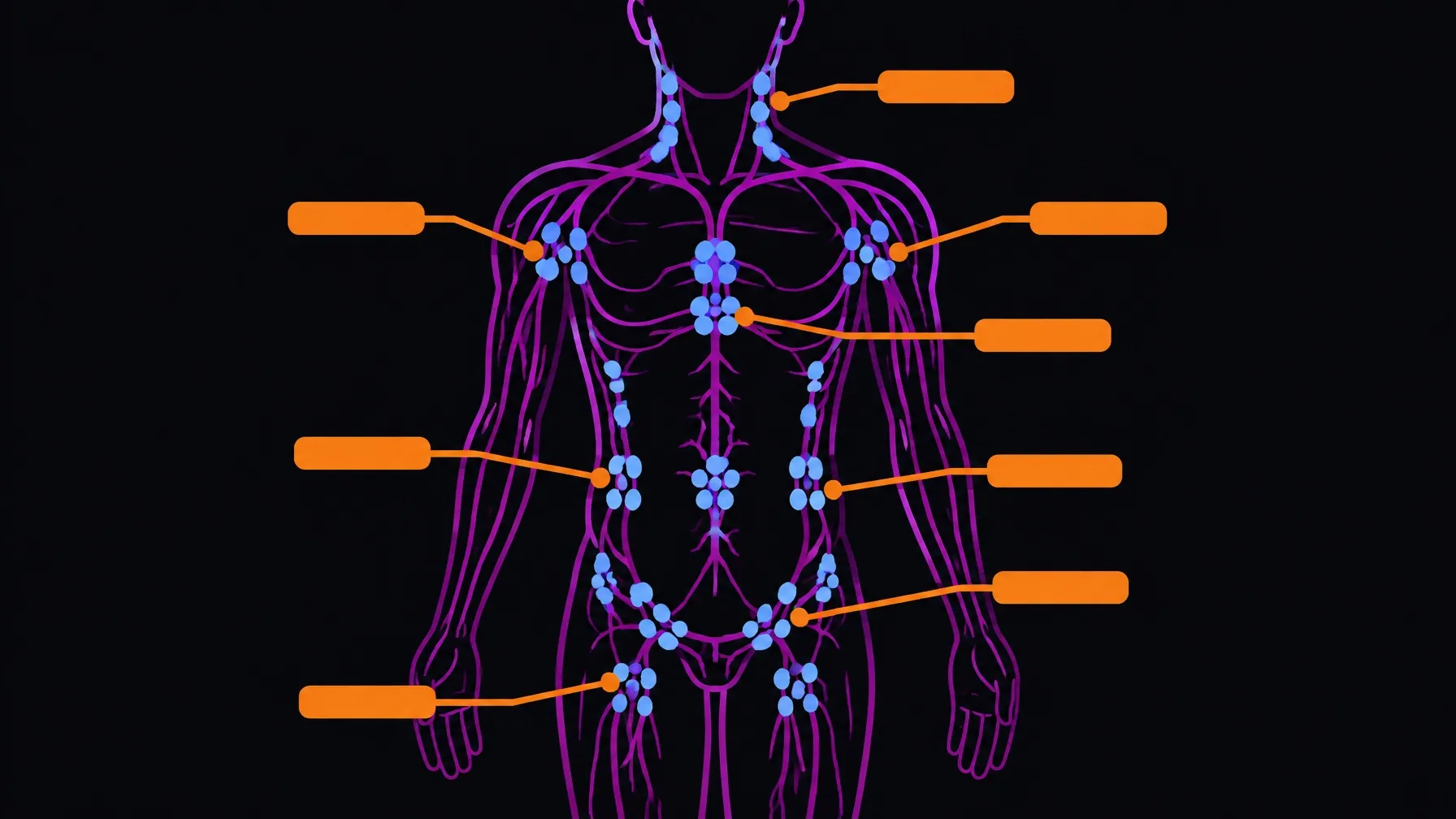
Important regional groups include:
- Cervical nodes: along the neck
- Supraclavicular nodes: above the collarbones
- Axillary nodes: in the armpits
- Mediastinal and hilar nodes: in the chest
- Mesenteric and abdominal nodes: around the digestive organs
- Iliac and pelvic nodes: deeper in the pelvis
- Inguinal nodes: in the groin
- Popliteal nodes: behind the knees
Their locations reflect regional drainage pathways, tissue territories, and relationships with blood vessels and organs.
A viral claim says that major lymph nodes cluster around joints because those joints move more. That explanation is too simple and is not supported by standard anatomy. Movement can help lymph transport, but it does not explain why every node group is located where it is.
4. Why the collarbone area matters
The lymphatic system eventually returns lymph to the venous circulation at two junctions called the venous angles.
Each venous angle is near the meeting point of the internal jugular vein and the subclavian vein:
- The right lymphatic duct drains the upper right region of the body.
- The thoracic duct drains most of the rest of the body, including both legs and much of the abdomen.
The thoracic duct usually travels upward through the chest and joins the bloodstream near the left collarbone.
In our city analogy, the venous angles are where the lymphatic highways merge back into the main blood circulation.
5. How lymph moves without a heart-like central pump
The lymphatic system does not have one central pump like the heart. That does not mean lymph simply sits still.
Several forces work together:
- Intrinsic vessel contractions: collecting lymph vessels contain smooth muscle that contracts rhythmically.
- One-way valves: valves help limit backward flow.
- Skeletal muscle movement: surrounding muscles compress vessels and nearby tissues.
- Breathing: pressure changes in the chest and abdomen influence lymph movement.
- Arterial pulsation: nearby blood vessel movement can add mechanical force.
- Tissue pressure: changes in the spaces around cells help fluid enter initial lymph vessels.
The tiny initial vessels act like neighborhood drains. Collecting vessels then use their own contractions and valves to move traffic along the roads.
6. Why ordinary movement can support lymph transport
Movement can help lymph transport because muscle contractions change pressure around lymphatic vessels.
This does not require a demanding workout. Depending on the person and the day, ordinary movement might include:
- Changing position
- Gentle ankle or wrist movement
- Seated leg movement
- Supported standing
- Walking a short distance
- Breathing comfortably while moving
The research literature often uses the word exercise. Here, Core & Curve Lab uses movement because the plan must account for pain, heaviness, swelling, fatigue, mobility differences, and fluctuating capacity.
Research in lymphedema suggests movement is generally feasible and may support function and symptoms, but the studies are varied. There is not one routine that fits every person.
7. What manual lymphatic drainage actually is
Manual lymphatic drainage, or MLD, is a specialized hands-on technique using light, rhythmic skin movements. A trained practitioner considers lymphatic pathways, tissue response, medical history, and the person's symptoms.
MLD is commonly used as one part of complete decongestive therapy for lymphedema. That broader approach may also include:
- Compression
- Movement
- Skin care
- Education
- Self-management
Evidence for MLD alone is mixed. It should not be described as a stand-alone answer for every type of swelling.
Harder pressure is not automatically better. MLD is not about forcefully pushing fluid through tissue. A general article also cannot provide a personal treatment sequence.
For additional capacity-aware context, read Lymphatic Drainage at Home: A Realistic Guide for Low-Energy Days.
8. Lipedema is not the same as lymphedema
Lipedema and lymphedema can overlap, but they are not the same condition.
Lipedema is a chronic disorder of subcutaneous adipose tissue. It commonly involves symmetrical enlargement of the limbs, pain or tenderness, easy bruising, and relative sparing of the feet.
Lymphedema involves impaired lymphatic transport and the buildup of protein-rich fluid in tissues.
Lipo-lymphedema means that a person has Lipedema with coexisting lymphedema or a clinically meaningful lymphatic component.
Lipedema and lymphatic dysfunction can coexist. That does not mean Lipedema automatically equals lymphatic failure.
A 2026 systematic review by Mortada and colleagues examined seven studies. Across the review, 311 women with Lipedema were included within a larger total sample. About 61% had reported normal lymphoscintigraphy. However, that should not be treated as one universal percentage.
The findings varied widely:
- One cohort reported about 17% normal scans.
- Another reported about 60% normal scans.
- Differences in disease stage, patient selection, imaging protocols, and interpretation likely contributed to the variation.
The review found that lymphoscintigraphic changes often suggested lymphatic overload or altered transport rather than clear lymphatic failure. Abnormal findings in some participants do not justify saying that Lipedema is a lymphatic failure disorder.
Lymphoscintigraphy is not used to confirm a Lipedema diagnosis. Lipedema remains a clinical diagnosis. Imaging may be used to evaluate suspected lymphedema, clarify mixed conditions, or support surgical planning.
9. "The Big Six": useful memory tool vs medical fact
"The Big Six" is sometimes used online as a memory tool for discussing several body regions involved in lymphatic care.
It is not an official anatomical classification.
Lists vary, but commonly mentioned areas include the neck, collarbone region, armpits, abdomen, groin, and the area behind the knees. These regions can be useful reminders when learning broad drainage pathways.
The limits matter:
- The lymphatic system is much larger than six areas.
- People do not need to "open" nodes.
- A memory tool does not replace anatomy or clinical assessment.
- A sequence that is appropriate for one person may not be appropriate for another.
10. Common lymphatic myths
Myth: "You need to open your lymph nodes."
Correction: This is not literal physiology. Lymph nodes are already connected to lymphatic vessels. They are not doors that can be opened by a particular movement.
Myth: Nodes are placed around joints because joints move the most.
Correction: Node locations reflect regional drainage, tissue territories, and vascular relationships. Movement may support lymph transport, but it does not prove this placement claim.
Myth: Everyone needs lymphatic drainage every day.
Correction: Care needs depend on diagnosis, symptoms, medical history, and goals. Not everyone needs MLD.
Myth: Harder massage moves more lymph.
Correction: MLD uses specialized, generally light techniques. More pressure is not automatically more effective and may be uncomfortable for sensitive tissue.
Myth: Lipedema is lymphatic failure.
Correction: Lipedema and lymphatic dysfunction can coexist. They should not be treated as identical.
Myth: You can "detox" your lymph.
Correction: The lymphatic system is a physiological transport and immune network, not a toxin-flushing service.
11. When professional help matters
Consider professional evaluation when swelling is new, persistent, asymmetric, painful, or changing.
A qualified clinician or lymphedema therapist may be helpful when you notice:
- New swelling in one limb
- Foot or hand involvement that is new for you
- Persistent pitting
- Skin thickening or texture changes
- Recurrent skin infections
- Increasing heaviness or loss of function
- Swelling after surgery, injury, cancer treatment, or infection
Seek urgent medical care for sudden one-sided swelling, severe pain, redness with fever, chest pain, or shortness of breath.
A professional can help distinguish Lipedema, lymphedema, venous conditions, medication effects, injury, and other causes of swelling.
12. C+CL resources and next steps
Core & Curve Lab uses an integrated model that connects nutrition education, MovementTracks™, and bodywork and lymphatic care.
Explore:
- Pathway #2: Lymphatic System, Lymphedema & Lipo-Lymphedema
- Pathway #17: Movement
- Pathway #18: Compression
- Pathway #19: Lymphatic Support
- Pathway #20: Capacity, Pacing & Cognitive Load
- Pathway #24: Tracking Symptoms, Appointments & Self-Advocacy
- MovementTracks™
- Movement, Not Exercise
SRP™, Nutrition OS™, and other systems are in development. TLP Method™ is currently available through a cohort waitlist.
These resources are educational. They do not claim to treat Lipedema or lymphedema.
Evidence framework
What we know / What we don't know
- Lymph moves through vessels, nodes, trunks, and ducts before returning to the bloodstream.
- Collecting lymph vessels have smooth-muscle contractions and one-way valves.
- Breathing and skeletal muscle movement can assist lymphatic transport.
- MLD is used within complete decongestive therapy for lymphedema.
- Lipedema and lymphatic dysfunction can coexist.
- The best movement approaches for different lymphedema presentations.
- How lymphatic findings vary across Lipedema stages and body types.
- Which imaging protocols are most consistent for Lipedema-related research.
- Some lymphatic changes seen in Lipedema may represent tissue-related overload or compensation rather than primary lymphatic failure.
- A universal "Big Six" anatomical classification.
- A need for daily MLD for every person.
- A specific massage sequence that suits every body.
- The claim that Lipedema itself is lymphatic failure.
- The claim that lymphoscintigraphy confirms Lipedema.
This article is education, not medical advice. It does not replace care from your own qualified clinicians.
Sources
- National Cancer Institute SEER Training Modules. Components of the Lymphatic System. https://training.seer.cancer.gov/anatomy/lymphatic/components/
- National Cancer Institute SEER Training Modules. Lymph Nodes. https://training.seer.cancer.gov/anatomy/lymphatic/components/nodes.html
- Null M, Arbor TC, Agarwal M. Anatomy, Lymphatic System. StatPearls. Updated 2023. https://www.ncbi.nlm.nih.gov/books/NBK557717/
- Ozdowski L, Gupta V. Physiology, Lymphatic System. StatPearls. Updated 2023. PMID: 32491765. https://pubmed.ncbi.nlm.nih.gov/32491765/
- Negrini D, Moriondo A. Lymphatic anatomy and biomechanics. The Journal of Physiology. 2011;589(Pt 12):2927-2934. PMID: 21486777. DOI: 10.1113/jphysiol.2011.206672. https://doi.org/10.1113/jphysiol.2011.206672
- International Society of Lymphology. The Diagnosis and Treatment of Peripheral Lymphedema: 2023 Consensus Document. Lymphology. 2023. PMID: 39207406. https://pubmed.ncbi.nlm.nih.gov/39207406/
- DiCecco S, Davies CC, Gilchrist L, Levenhagen K, Letellier ME, Rivera A, Weiss J, Klose G, Hodgkins L, Anderson E, Cheville A, Moore K, Koehler L. Complete decongestive therapy phase 1: an expert consensus document. Medical Oncology. 2024;41:304. PMID: 39487245. https://doi.org/10.1007/s12032-024-02407-4
- Wittenkamp MC, Christensen J, Vinther A, Juhl CB. The effect of exercise in patients with lower limb lymphedema: a systematic review. Acta Oncologica. 2025;64:484-498. PMID: 40165003. DOI: 10.2340/1651-226X.2025.42560. https://pubmed.ncbi.nlm.nih.gov/40165003/
- Kruppa P, Crescenzi R, Faerber G, Forner-Cordero I, Cornely M, Shayan R, Karnezis T, Simarro JL, Frederichi de Souza P, Herbst KL, Ghods M, Michelini S. Lipedema World Alliance Delphi Consensus-Based Position Paper on the Definition and Management of Lipedema. Nature Communications. 2026;17:427. DOI: 10.1038/s41467-025-68232-z. https://www.nature.com/articles/s41467-025-68232-z
- Mortada H, Alsaif MA, AlJohani A, Altuwaijri AM, Alshomer F. Lymphoscintigraphic Findings in Patients With Lipedema: A Systematic Review. Plastic and Reconstructive Surgery Global Open. 2026;14(8):e8015. PMID: 42578114. https://pubmed.ncbi.nlm.nih.gov/42578114/
- Chachaj A, Dudka I, Jeziorek M, Sowicz M, Adaszyńska A, Szuba A. Lymphoscintigraphic alterations in lower limbs in women with lipedema in comparison to women with overweight/obesity. Frontiers in Physiology. 2023;14:1099555. PMID: 37101701. DOI: 10.3389/fphys.2023.1099555. https://doi.org/10.3389/fphys.2023.1099555
- Eretta C, Di Pumpo F, Bizzarri S, Duca V, Bianchi C. Does lymphoscintigraphy have a role in the diagnosis and management of lipedema? Veins and Lymphatics. 2025;14. DOI: 10.4081/vl.2025.14438. https://doi.org/10.4081/vl.2025.14438