Why Rigid Meal Plans Fail Fluctuating-Capacity Bodies
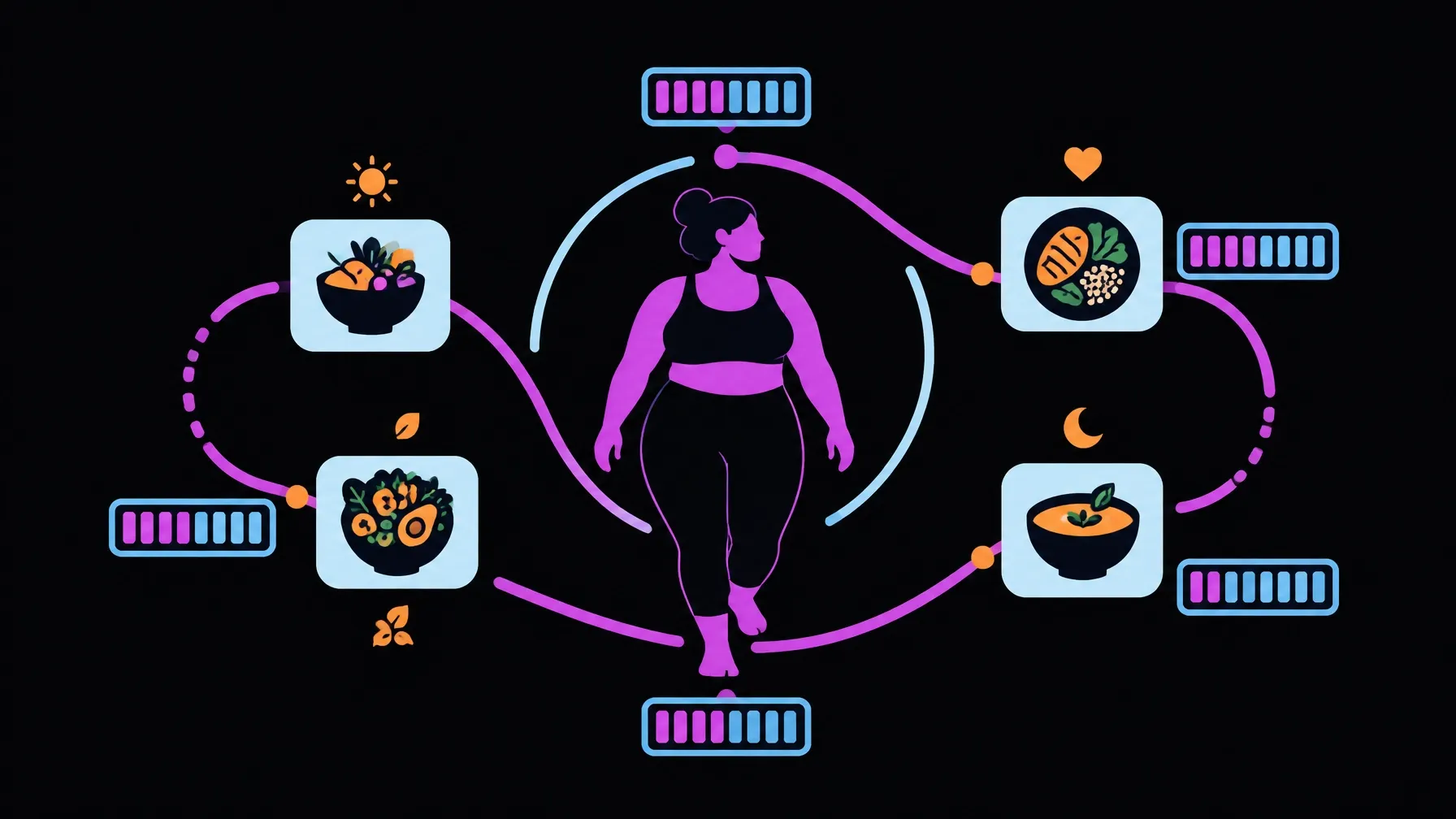
A rigid meal plan can look supportive on paper. It may include balanced recipes, meal times, shopping lists, and clear nutrition goals.
But many plans quietly assume that your body will offer the same energy, appetite, standing tolerance, executive function, and cooking capacity every day.
For women living with late-stage Lipedema, chronic pain, fatigue, changing mobility, and fluctuating capacity, that assumption can make a reasonable plan feel impossible.
The plan was never the problem.
The problem is a plan built for a stable-capacity body.
Built for bodies that don't have the same capacity every day.
This is the starting point for Nutrition OS™: Core & Curve Lab's next ecosystem pillar after MovementTracks™ and SRP™. Nutrition OS is being developed as an adaptive nourishment system for real life, supported by education, coaching, and practical tools.
Instead of asking your body to keep up with the plan, we help the plan adapt to the body.
On this page
The hidden assumptions inside a rigid meal plan
Traditional meal plans often ask you to do the same things repeatedly:
- Shop for several specific ingredients.
- Stand at the counter and prepare meals.
- Follow recipes in a particular order.
- Eat at set times.
- Finish a prescribed amount.
- Tolerate the same textures, smells, and temperatures.
- Repeat the routine even when pain, fatigue, or appetite changes.
None of these tasks are inherently wrong. The issue is treating them as universally available.
A plan can be nutritionally thoughtful and still fail because it does not account for the body carrying it out.
For women with late-stage Lipedema, a "simple" cooking task may involve prolonged standing, bending, lifting, navigating the kitchen, managing pain, or recovering afterward. A shopping trip may use more capacity than expected. Appetite may be low. A medication may affect nausea or fullness. Executive function may be limited by fatigue, stress, poor sleep, or the mental load of managing symptoms.
That is not a character flaw.
It is information about the system.

What changes from day to day?
Fluctuating capacity is not only about energy. It can affect nearly every step between deciding what to eat and actually eating it.
Your day may change based on:
- Appetite: You may feel hungry one day and struggle to tolerate a full meal the next.
- Pain: Pain can make standing, chopping, carrying, or cleaning more difficult.
- Fatigue: A meal that is manageable at breakfast may be unrealistic by dinner.
- Standing tolerance: Cooking may need to happen seated, in short intervals, or not at all.
- Mobility: Getting to the store, unloading groceries, or reaching items may require support.
- Executive function: Planning, sequencing, and decision-making can become harder when your system is overloaded.
- Sensory tolerance: Smells, textures, temperature, or food volume may suddenly matter more.
- Shopping capacity: You may not have the energy to shop, or delivery may not be available that week.
- Recovery needs: The cost of preparing a meal may show up later as increased fatigue or pain.
A plan that ignores these factors creates a false choice: follow the plan perfectly or feel as if you have failed.
Nutrition OS™ takes a different approach. It asks: What form of nourishment is realistic today, and what would make it easier?
The evidence: what we know and what we do not
There is no single scientifically established "Lipedema diet." Current research and clinical guidance explore several dietary patterns, including Mediterranean-style and lower-carbohydrate approaches, but the evidence remains limited and not settled.
Nutrition can support general health, metabolic health, function, and a person's overall wellness. It should not be presented as a cure, reversal strategy, or guaranteed way to change Lipedema tissue.
Evidence framework
No single Lipedema-specific diet has been established as the universal best approach. Individualized nutrition and sustainable eating patterns are more appropriate than short-term restrictive diets.
Mediterranean-style and lower-carbohydrate patterns have been studied in Lipedema-related nutrition research, but much of the evidence is limited, small-scale, or not specific to late-stage Lipedema.
A capacity-adapted nourishment system may improve consistency, reduce decision burden, and support eating enough on difficult days. This is a practical framework, not a proven Lipedema treatment.
A specific food, supplement, meal timing strategy, or diet has been proven to cure or reverse Lipedema.
This distinction matters. Honest nutrition support leaves room for what research can show, what it cannot yet show, and what must be individualized with a qualified healthcare professional.
What a capacity-adapted approach looks like
Nutrition OS™ is being built around systems rather than tips. A tip may help once. A system gives you options when the day changes.
1. Start with capacity, not compliance
Before choosing a meal, ask what kind of day your body is having.
You might use a simple check-in:
- How much energy do I have for food today?
- Can I stand long enough to prepare something?
- Do I have access to groceries?
- What textures or smells feel manageable?
- Is my appetite low, average, or higher than usual?
- Do I need food now, or do I need an option I can prepare later?
This is not permission to ignore nourishment. It is a way to match the task to the capacity available.
Built for bodies that don't have the same capacity every day means a plan should include more than one version of success.
2. Create low-capacity nourishment options
On a low-capacity day, the goal may be to make eating possible, not impressive.
No-cook and minimal-prep options can include combinations such as:
- Yogurt or a dairy-free alternative with fruit and seeds.
- Eggs, pre-cooked or quickly prepared.
- A ready-to-eat soup with added beans, lentils, chicken, tofu, or another tolerated protein.
- A protein drink or smoothie when chewing or meal volume feels difficult.
- Pre-washed greens with canned fish, beans, eggs, or prepared chicken.
- Hummus with vegetables, crackers, or another tolerated carbohydrate.
- Cottage cheese, tofu, or another convenient protein source.
- Nuts, seeds, fruit, or cheese paired with something more substantial.
- Frozen meals that meet your needs and require little preparation.
These are not "cheating" or emergency morality tests. They are practical tools.

3. Support protein, fiber, hydration, and enough food
If weight is changing, appetite is reduced, or a person is using a prescribed GLP-1 medication, nutrition planning may need to pay closer attention to protein and muscle support.
General weight-management research suggests that preserving muscle during weight loss involves adequate protein, appropriate movement or resistance work when feasible, and enough overall nourishment. Lipedema-specific research on GLP-1 medications and muscle preservation is still developing.
When appetite is low, smaller portions may be easier. Some people may tolerate protein earlier in a meal, softer foods, or liquid options more comfortably. The right approach depends on the person.
Fiber can support digestive health and help create satisfying meals. Hydration supports normal body functions and may be especially important when fiber intake changes or constipation is a concern. Neither fiber nor hydration is a standalone treatment for Lipedema, and fluid needs may differ with medical conditions or clinician guidance.
The broader goal is not to build a perfect plate every time. It is to create enough reliable options that your body is not left without nourishment when capacity drops.
4. Let food preferences belong in the plan
Food preferences are not a distraction from nutrition.
Taste, culture, texture, allergies, budget, household routines, ethics, sensory needs, and past experiences all shape whether a plan can work. If a plan excludes the foods you can actually tolerate or enjoy, it is not individualized.
A capacity-adapted plan might include:
- Familiar foods alongside new foods.
- Several protein options rather than one required source.
- Soft, crunchy, warm, or cold choices depending on sensory tolerance.
- Flexible meal timing.
- Cultural foods that support connection and satisfaction.
- Convenience foods without shame.
- A short list of "reliable foods" for difficult days.
Nourishment should support your life, not require you to become a different person before you are allowed to eat.
Cooking with pain or limited standing tolerance
Cooking does not have to be an all-or-nothing activity.
You might adapt the kitchen by:
- Preparing food seated whenever possible.
- Keeping frequently used items within easy reach.
- Using pre-cut, frozen, canned, or ready-to-eat ingredients.
- Choosing one-pot or sheet-pan meals to reduce cleanup.
- Breaking preparation into short steps across the day.
- Asking someone else to shop, chop, lift, or clean.
- Preparing extra portions on a higher-capacity day and freezing them.
- Using adaptive tools that reduce grip, bending, or standing demands.
The best kitchen system is not the one that looks most ambitious. It is the one that reduces friction and protects your available capacity.
This is the same principle behind MovementTracks for Low-Energy Days: support should meet the day you are actually having.
Nourishment without diet-culture shame
A rigid plan can become another way to measure whether you are "good" or "bad."
We reject the message "just lose weight" because it ignores Lipedema, pain, capacity, muscle, function, access, and the full context of a person's health.
A weight-focused conversation may be appropriate for some people and harmful for others. If weight change is part of your healthcare plan, it should be discussed with care and without pretending that body composition, function, and tissue distribution are interchangeable.
The important questions are not only how much weight changes, but what happens to body composition, muscle, strength, mobility, and daily function.
Nutrition is one part of holistic Lipedema management. It can sit alongside medical care, bodywork, lymphatic care, movement, compression when recommended, rest, social support, and practical adaptations.
You can explore At-Home Lymphatic Drainage for Lipedema and Why We Say "Movement," Not "Exercise" for examples of how Core & Curve Lab approaches support without demanding push-through behavior.
Building Nutrition OS™ in public
Nutrition OS™ is being developed in the open, with the same systems-not-tips approach described in I'm Building Core & Curve Lab in Public.
That means the framework will continue to be shaped around real questions:
- What helps on a pain-heavy day?
- What makes meals possible when standing is limited?
- How can shopping require less energy?
- How do we support muscle without turning food into another source of pressure?
- How can a plan include both low-capacity and higher-capacity options?
- What does sustainable nourishment look like when life is already full?
Built for bodies that don't have the same capacity every day.
That is not a slogan added after the fact. It is the design requirement.
Instead of asking your body to keep up with the plan, we help the plan adapt to the body.
Apply for the Nutrition OS Cohort
The Nutrition OS Cohort is a future cohort currently being developed for women with late-stage Lipedema and fluctuating capacity.
If this approach speaks to the reality of your life, you can apply for the Nutrition OS Cohort. Application details and timing will be shared as the cohort is prepared.
This is not a rigid diet, a weight-loss challenge, or a promise of Lipedema reversal. It is an opportunity to explore adaptive nourishment, practical systems, and a more compassionate relationship with food.
Built for bodies that don't have the same capacity every day.
Disclaimer
This article is educational and does not diagnose, treat, or replace medical, nutrition, rehabilitation, or mental health care. Nutrition needs can vary with medications, kidney or gastrointestinal conditions, diabetes, allergies, eating-disorder history, pregnancy, and other health factors. Speak with an appropriately qualified professional before making significant changes to your eating pattern or medications. Do not change GLP-1 medication or any other prescribed treatment without your prescriber.
Personal experiences and practical frameworks should not be treated as scientific evidence or a diagnosis. There is currently no evidence proving that Lipedema causes post-exertional malaise (PEM). Seek appropriate clinical guidance for new, severe, or concerning symptoms.
Sources and further reading
- Cleveland Clinic: Lipedema — https://my.clevelandclinic.org/health/diseases/17175-lipedema
- Lipedema: Nutrition and Dietary Approaches, review — https://pmc.ncbi.nlm.nih.gov/articles/PMC7465366/
- Lipedema and nutrition research overview — https://pmc.ncbi.nlm.nih.gov/articles/PMC8707844/
- 2024 German S2k Lipedema Guideline — https://onlinelibrary.wiley.com/doi/full/10.1111/ddg.15513